Behind the Maison
Maison des Reflets is the name I eventually gave to something I had been doing quietly for years: drawing the clothes I couldn’t find, and then finding a way to have them made. It is very small, it is deliberately slow, and this page is about how it works.
It began as a list
At the back of my black notebook there has always been a list. It started as a note to myself for markets, a way of remembering exactly what I was looking for so that I wouldn’t come home with something that was nearly right: a blouse with a wide, ruffled edge at the neck, a satin top that fastened with small hooks, a corset with sleeves that opened like bells.
I looked for years and found versions of almost all of them. None was quite right. The satin would be too stiff, or the cotton too thin to hold a ruffle, or the sleeves would stop just where they shouldn’t. Eventually it became obvious that if I wanted these things to exist, I would have to draw them properly and find someone who could help me make them.
That is really all the Maison is: the list, made real one line at a time.
The name came later, and it is more literal than it sounds. Everything here reflects something else, a blouse I once tried on in another city, a painting, a person I love, and I liked the idea of a house that admitted as much instead of pretending to have invented it all.
Silhouette first, then the collar
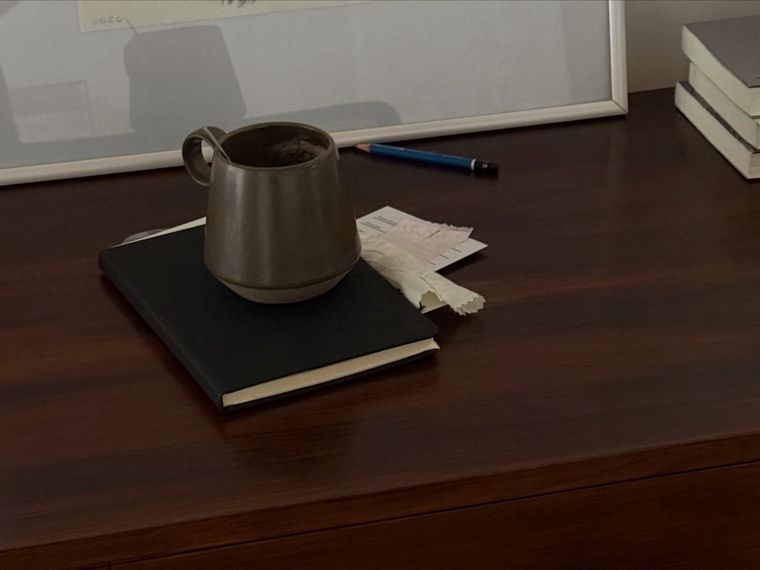
Every piece starts in pencil, in the same black notebook. I draw the silhouette first, quite loosely, just the shape a garment makes against the body, and then I leave it alone for a day or two. If I still want it when I come back to it, I move on to the collar.
The collar is where most of my time goes. It sits nearest the face, it is what people look at while you are talking to them, and in old portraits it is often the most carefully painted thing in the picture. I redraw it more times than I would like to admit, sometimes for the sake of two millimetres, changing the width, the depth of a curve, the exact point where a ruffle begins. The sleeves come after that, and the length last of all, which I check against my own arm.
By the time a drawing goes to the atelier it has usually been crossed out and started again at least once. I don’t tear out the failed pages. Every so often one of them turns out to have been right after all.
Choosing the cloth
Once a drawing has survived, I go looking for the cloth, and this is the part of the work that takes longest and shows least. A shape that looks right on paper can be ruined by a fabric that is a fraction too stiff or too soft, and the only way I know to tell is by handling it: folding a corner over my hand, crushing it in my fist for a few seconds to see how it recovers, holding it up to the window to see what the light does through it.
For the Satin Top I wanted a satin that would move when the wearer moved and lie still when she didn’t, with a sheen soft enough to look expensive rather than shiny. For the Blouse Vienna the cotton had to be light enough to gather at the waist and still have the body to hold a ruffle at the collar after a day’s wear and a wash. I wash every sample at least twice before I decide anything, because a cloth that only looks good new is no use to anyone who means to keep a piece for years.
Romance fits in a centimetre of lace
Lace came to me through my grandmother, Adela, and I have written about her in the Journal. What she left me, besides the drawers themselves, is a certain strictness about it.
Lace is very easy to overdo. Once there is too much of it, it stops meaning anything, and the garment looks dressed up rather than looked after. At the Maison I use it sparingly and only where it has a job to do. On the Corset Julia it is a single fine line of white along the neckline, the hem and the cuffs, and nowhere else. I would rather someone noticed it on the second look than on the first.
The Maison borrows its colours from the rooms it lives in
I never sat down and chose these colours. They were already around me, and all I did was notice them and stop looking for others.
- Black
The colour I have worn almost every day since I was fourteen. In satin and cotton it has to look like depth, never like an absence, which is harder to get right in cloth than in paint.
- Ivory
The colour of good writing paper before anything has been written on it. It must never lean towards yellow; then it looks like age instead of something waiting to happen.
- Chocolate
Dark wood: the doors of old Paris buildings, the legs of my desk, and the parquet in our flat, which creaks in the same three places every morning.
Four pieces, sewn in the 11th
Drawing is the part I do on my own. The making happens with Graça, in her small atelier in the 11th arrondissement, and it is at her table that a sketch has to become something a person can actually move in. Most of my drawings are corrected there, usually for the better.
We make one season at a time, and each season is four pieces. People sometimes ask why four. The honest answer is that four is what the list held when I started, and I didn’t want to add anything simply to make the rail look fuller. The less honest answer, which I give at dinners, is that four is the number of pieces I can fit on the rod in my hallway, and that is also true.
Each piece leaves in a kraft box tied with ribbon, with a card I have dated by hand. I hope you keep the box afterwards.
A correspondence, not a transaction
There is no basket on this site, and nothing is paid for here. You write to me instead, and I write back. The practical side, sizes and timing and delivery, is explained on the Boutique page.
I know it is slower than a checkout. I chose it because I like to know a little about who each piece is going to, and because people tend to say more in a letter than they ever would in a form. Most of my correspondence is practical, measurements and dates and addresses, but every so often someone tells me why they want the blouse, and those are the letters I keep.